




09 Sep Bariatric Surgery for BMI 30–35Kg/m2 in Punjab : Is It Worth It?
For a long time, bariatric surgery was treated like a “last resort.” Something you only considered if your BMI was 40+, or 35+ with scary health problems.
But real life is messier than that.
Plenty of people sit in the BMI 30 to 35 range and still feel stuck. Weight keeps creeping up. Blood sugar looks “borderline” until one day it is not borderline anymore. Fatty liver shows up on a scan. Sleep is trash. Knees hurt. PCOS symptoms flare. You try the usual cycle of diet, gym, apps, protein shakes. It works. Then it stops working. Then you regain. Again.
So the question comes up, quietly at first.
Is bariatric surgery for BMI 30 to 35 actually worth it?
Not for everyone. But for some people, yes. And the reason is not only weight loss. It is metabolic health. It is diabetes prevention or remission. It is getting out of that slow slide where every year something gets worse.
Let’s talk about it in a practical way.
First, what does BMI 30 to 35 even mean?
BMI is a blunt tool. It does not measure body fat directly, it does not see muscle, and it definitely does not understand your personal history.
Still, BMI categories are used because they are simple and standardized:
- BMI 30 to 34.9 is generally classified as Obesity Class I
- BMI 35 to 39.9 is Obesity Class II
- BMI 40+ is Obesity Class III
For years, surgery was mostly “allowed” (by guidelines and insurance rules) in BMI 40+, or BMI 35+ with conditions like diabetes, hypertension, sleep apnea.
Now that is shifting. Because the science around obesity and metabolism has shifted.
Why would someone with BMI 30 to 35 consider surgery?
This is usually the part people misunderstand.
They assume surgery is only about losing a lot of kilos quickly.
But in the BMI 30 to 35 group, the most common motivation is this:
You are not just fighting weight. You are fighting what weight is doing to your metabolism. Some common scenarios:
1) Type 2 diabetes or “almost diabetes”
Maybe you already have type 2 diabetes. Or you have prediabetes and strong family history. Or your HbA1c keeps trending up no matter what you do.
This is where metabolic surgery becomes a serious conversation, even at BMI 30 to 35.
2) PCOS, infertility, irregular cycles
PCOS can improve with weight loss, yes, but also with improved insulin sensitivity. Some women are not looking for a “smaller body.” They are looking for ovulation, stable hormones, and a real shot at pregnancy without constant medication changes.
3) Fatty liver disease (NAFLD or NASH)
Fatty liver is incredibly common and often ignored until it progresses. In the earlier stages, weight loss helps. But keeping weight off is the hard part.
4) High blood pressure, high triglycerides, low HDL
The typical metabolic syndrome package. Even if each number is only “mildly abnormal,” together they add up. Cardiovascular risk is not a single switch. It is a slow build.
5) Sleep apnea, reflux, joint pain
Even at BMI 32 or 33, some people have significant symptoms, especially if weight is concentrated around the abdomen and neck.
6) The repeated regain pattern
This one matters more than people admit.
If you have lost and regained weight multiple times, your body often becomes more resistant to future loss. Not because you are weak. Because biology adapts.
Surgery can change the equation by changing hunger signals, satiety, gut hormones, and the “set point” effect that makes maintenance so brutal.
Is surgery “allowed” at BMI 30 to 35?
Today, many metabolic and bariatric societies recognize that patients with BMI 30 to 35 with uncontrolled type 2 diabetes or significant metabolic disease may benefit from surgery.
But here is the key point.
Even if a guideline says something is appropriate, you still need an individualized evaluation. If you are exploring this, a clinic that focuses on obesity and metabolic care (not just “weight loss packages”) matters. That is
exactly the kind of work centers like CODSILS focus on, where the discussion includes diabetes, metabolic health, minimally invasive approaches, and long term follow up. You can read more at www.codsils.com, then book a
consultation when you want a real case specific opinion.
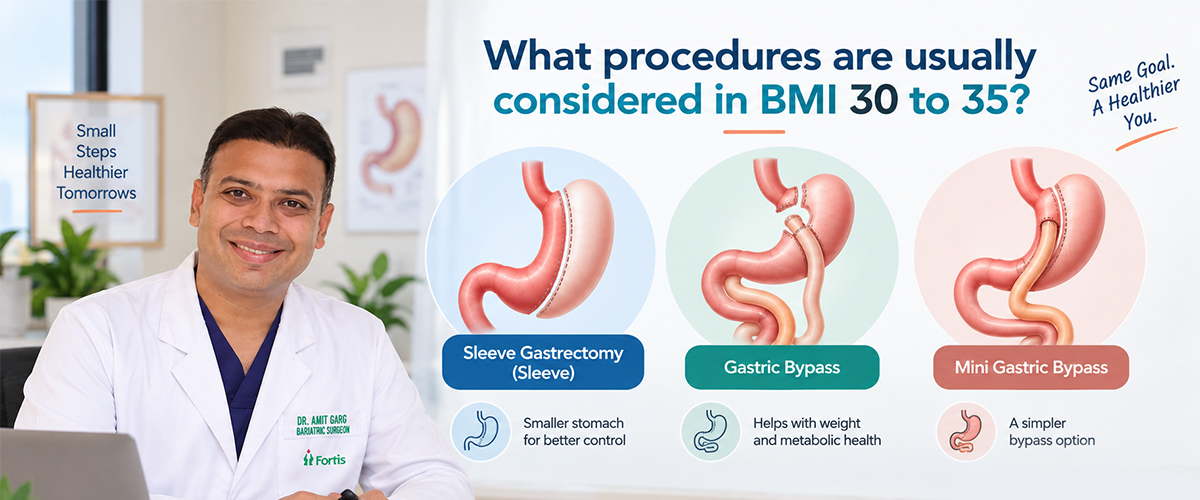
What procedures are usually considered in BMI 30 to 35?
Not every surgery is the right fit for this BMI range. The goal is usually strong metabolic benefit with a risk profile that makes sense.
1) Sleeve Gastrectomy (Sleeve)
Sleeve gastrectomy reduces the stomach size and also affects hunger hormones like ghrelin.
Why people choose it:
- Strong weight loss results for many patients
- Simpler anatomy compared to bypass
- Good improvement in metabolic markers for a lot of people
Things to be aware of:
- Reflux can worsen in some patients
- Weight loss and diabetes control can be excellent, but in severe diabetes, bypass may outperform sleeve
2) Roux-en-Y Gastric Bypass (Bypass)
Bypass changes food routing and has a powerful metabolic effect.
Why it gets considered in BMI 30 to 35:
- Strong results for type 2 diabetes remission or major improvement
- Often helps reflux (especially compared to sleeve)
- Strong long term data
Things to be aware of:
- More complex than sleeve
- Requires lifelong attention to supplementation and follow up
3) Mini Gastric Bypass (One Anastomosis Gastric Bypass)
Some centers offer this as well. It can offer strong weight loss and metabolic outcomes, but suitability depends on individual anatomy, reflux risk, and surgeon preference.
The best procedure is not the “best procedure.” It is the best procedure for you.
And that depends on:
- your diabetes duration and medication needs
- your reflux history
- your eating patterns (grazing vs large meals)
- your lab work
- your expectations and willingness for follow up
4) Sleeve with loop bipartition or modified SASJ –
At CODSILS, Mohali, this is the most common metabolic procedure performed and it out performs all old procedures in every expect with a biggest benefit of maintaining access to duodenum and CBD.
What kind of results can someone with BMI 30 to 35 realistically expect?
This is where honesty helps.
If your BMI is 32, you are not going to lose 60 kg. That is not the point. The point is getting to a healthier range and staying there, while improving metabolic disease.
Typical benefits people aim for:
Weight loss
Many patients in this BMI range may lose a meaningful percentage of their excess weight. They often end up somewhere in the mid to high 20s BMI range, sometimes lower, depending on starting point and procedure.
But the more important part is maintenance. Sustained weight loss.
Diabetes improvement or remission
This is a big one.
For some patients with type 2 diabetes (especially shorter duration, less insulin dependence), surgery can:
- significantly reduce medications
- improve HbA1c quickly
- improve insulin sensitivity
Some people see changes within days to weeks, even before major weight loss, because gut hormones shift.
Lipids, blood pressure, fatty liver
These often improve alongside weight reduction and insulin sensitivity. Fatty liver can improve substantially with sustained weight loss.
Quality of life stuff
Not a medical term, but real:
- better sleep
- more energy
- less joint pain
- easier movement
- improved confidence, sometimes, though that is complex and personal

So why not just do medication instead?
Good question, because now we have GLP-1 medications (and similar) that can be very effective.
For BMI 30 to 35, the most reasonable comparison is often:
Surgery vs modern medical therapy (anti-obesity meds) plus lifestyle.
And the answer is not one size fits all.
When medication might be the better first step
- You have not tried a structured medical weight loss program with proper follow up
- You respond well to GLP-1 therapy and can tolerate it
- You can afford the medication long term (this is not a small point)
- You prefer a non surgical route and your metabolic disease is not advanced
When surgery starts to make more sense
- You have type 2 diabetes that is not well controlled
- You have tried medication and regain happens after stopping, or side effects limit you
- You want a one time intervention with long term metabolic effects (with follow up, of course)
- You have multiple obesity related conditions piling up
- You are stuck in the lose regain cycle for years and it is affecting health and life
Also. People rarely talk about this clearly.
Some patients do both. Medication before surgery to reduce risk. Or medication after surgery if weight regain happens years later. This is not a purity test. It is healthcare.
What are the downsides, specifically for BMI 30 to 35?
This is where the “is it worth it” question really lives.
Because if you are BMI 31 and generally healthy, the risk tolerance is different than someone BMI 50 with severe sleep apnea and diabetes.
Here are the main concerns.
1) Surgery is still surgery
Even with minimally invasive laparoscopic approaches, there are risks:
- bleeding
- infection
- leakage (rare, but serious)
- blood clots (rare, but serious)
- anesthesia risks
The absolute risk may be low in experienced hands, but it is not zero.
2) Nutritional deficiencies (especially with bypass)
Iron, B12, folate, vitamin D, calcium, protein. These need attention. Lifelong supplementation is not optional. Follow up labs are not optional.
3) Lifestyle changes are required
Surgery helps appetite and portion control, but it does not remove:
- emotional eating patterns
- alcohol risk
- snacking habits
- the need for protein first eating
- the need for movement
People who treat surgery like a finish line often struggle. People who treat it like a tool tend to do well.
4) Reflux considerations
Sleeve can worsen reflux in some people. If you already have GERD, that needs to be discussed seriously.
5) The mental side
Some people feel relief after surgery. Some feel complicated grief, or body image confusion, or social changes. This is normal. Screening and support matter.
Who is a good candidate at BMI 30 to 35?
Not a perfect checklist, but generally, the strongest candidates are people who:
- have type 2 diabetes, especially if not well controlled
- have multiple metabolic risk factors (fatty liver, high BP, dyslipidaemia)
- have tried structured non-surgical approaches and cannot sustain results
- understand surgery is a tool and are willing to do follow up
- can commit to nutrition guidance, supplements, and lab monitoring
And equally important.
If you are expecting surgery to fix everything in your life, it will disappoint you.
If you are expecting it to give you a fair chance to control appetite and metabolism, it can be life changing.
What should your decision be based on?
Try not to decide based on fear or hype.
Not “surgery is extreme” and not “surgery is the easy way.”
Instead, base it on these practical points:
1) How severe is your metabolic disease right now?
If your HbA1c is climbing, fatty liver is progressing, or medications keep increasing, doing nothing is also a decision. A costly one, long term.
2) How long have you been trying to manage weight?
A few months is different from ten years.
3) What has your pattern been?
If it is always loss, then regain, then higher baseline, that pattern tends to continue unless something changes.
4) What is your best non surgical plan, realistically?
Not the fantasy version. The real version you can sustain.
5) Do you have access to a team that actually follows patients long term?
Surgery without follow up is where problems happen. Nutrition confusion, deficiencies, regain, unmanaged reflux, frustration.
A proper bariatric and metabolic clinic should feel like a system, not a one day procedure. This is where specialized centers like CODSILS stand out, since the focus is not just the operation but the medical context around obesity and
diabetes care. If you want to explore whether you fit the BMI 30 to 35 criteria, start by reading their patient resources at www.codsils.com and consider booking a consultation for an individualized plan.
If you want a starting point that’s not overwhelming, CODSILS www.codsils.com has patient focused information on obesity, metabolic care,
and minimally invasive bariatric options, and it is a good place to book a consultation if you want clarity on whether surgery makes sense for your specific situation.
FAQs (Frequently Asked Questions)
01 – What does a BMI of 30 to 35 mean and how is it classified?
BMI between 30 and 34.9 is classified as Obesity Class I, while 35 to 39.9 is Obesity Class II. BMI is a simple, standardized measure but does not directly assess body fat or personal health history.
02 – Is bariatric surgery recommended or allowed for individuals with BMI 30 to 35?
Many metabolic and bariatric societies now recognize that patients with BMI 30 to 35 who have uncontrolled type 2 diabetes or significant metabolic disease may benefit from surgery.
03 – What types of bariatric procedures are suitable for people with BMI between 30 and 35?
Common procedures include Sleeve Gastrectomy, Roux-en-Y Gastric Bypass, Mini Gastric Bypass and sleeve plus gastric bypass. These surgeries offer strong metabolic benefits and weight loss but differ in complexity, risks, and effects on conditions like reflux or diabetes.
04 – How does bariatric surgery help with metabolic health beyond weight loss?
Surgery can improve insulin sensitivity, promote diabetes remission or prevention, reduce fatty liver progression, improve hormonal balance in PCOS, lower cardiovascular risk factors, and alter hunger hormones to support sustained weight maintenance.
05 – What should patients consider when exploring bariatric surgery at BMI 30 to 35?
Patients should seek care from specialized obesity and metabolic centers that provide comprehensive evaluations focusing on individual health profiles. Surgery decisions should be medical and personalized rather than based solely on BMI thresholds.
